Industrial floor slab repair: fix cracks before OSHA does
⏱️ 15 min read · Last updated: 2026
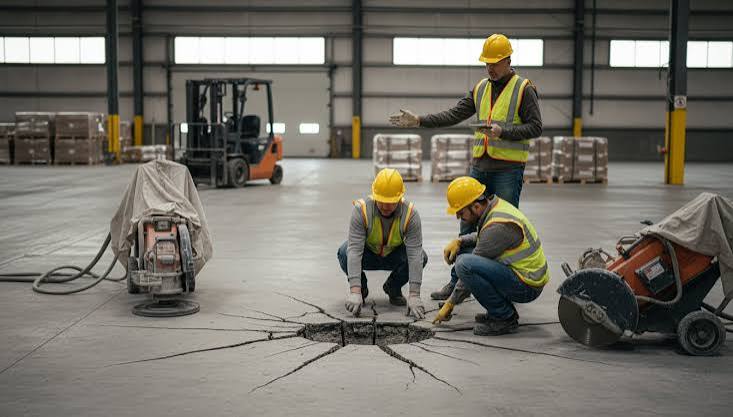
Industrial floor slab repair is more than maintenance. It is a safety and compliance issue that starts the moment a floor creates a trip hazard or affects equipment movement. In an industrial setting, even a small crack, joint failure, or settled panel can lead to citations, downtime, and higher repair costs. This article explains how to spot the warning signs, choose the right repair method, and keep your floor compliant before a minor defect becomes a bigger problem.
- OSHA trip hazard threshold: Any vertical floor elevation change of 1/4 inch (6.4 mm) or more is a trip hazard under OSHA 1910.22.
- Crack repair thresholds: Cracks from 1/16 inch to 1/4 inch wide require sealing, and cracks wider than 1/4 inch require structural assessment and repair.
- Floor flatness standards: General industrial operations require FF 25–35, while very narrow aisle forklift environments require FF 60 or higher.
The issue is easy to miss at first because many concrete floors look serviceable long before they become safe. A small defect can remain hidden until a routine inspection, a forklift pass, or a loading dock shift exposes it. That is why industrial floor slab repair should begin with measurement, not appearance.
In practice, the best-maintained floors are not always the newest floors. They are the ones on a regular inspection cycle, with documented measurements and a clear repair protocol before the damage spreads. Once the cause is identified early, the repair is usually faster and less expensive.
Why most facility managers treat industrial floor slab repair as a cosmetic problem — and why that backfires
Most facility managers wait until a floor looks bad before they act. That delay often turns a simple crack fill into a larger structural repair, because moisture, load stress, and slab movement keep working while the problem stays open.
OSHA 1910.22 runs on a compliance clock, not a visual one. A floor can look acceptable and still fail because a control joint heaves 3/8 of an inch or a settled panel creates a 1/4-inch trip hazard.
That is why industrial floor slab repair should start with measurement, not appearance. If the floor crosses the threshold, the repair becomes urgent even if the damage seems minor.
The financial logic is just as direct. Structural concrete repairs in industrial settings often last longer than surface coatings and sealers, which is why early intervention usually costs less than waiting for a major failure.
That timing difference matters. For a 20,000-square-foot facility, the gap between a sealing project and a partial slab replacement can be significant once downtime and traffic rerouting are included.
There is also a staffing issue. Qualified concrete repair crews are harder to book than many facilities expect, especially when several locations are competing for the same labor pool.
Facilities that wait until after a citation often find the earliest crew is weeks out. During that time, inspections keep building the liability record.
The smarter approach is to treat the floor like mechanical equipment. Set an inspection interval, document measurements against a defined threshold, and repair by objective criteria instead of visual judgment. With that approach in place, it becomes easier to decide what should be fixed now and what can be monitored.
How do I fix an OSHA trip hazard on my warehouse floor?
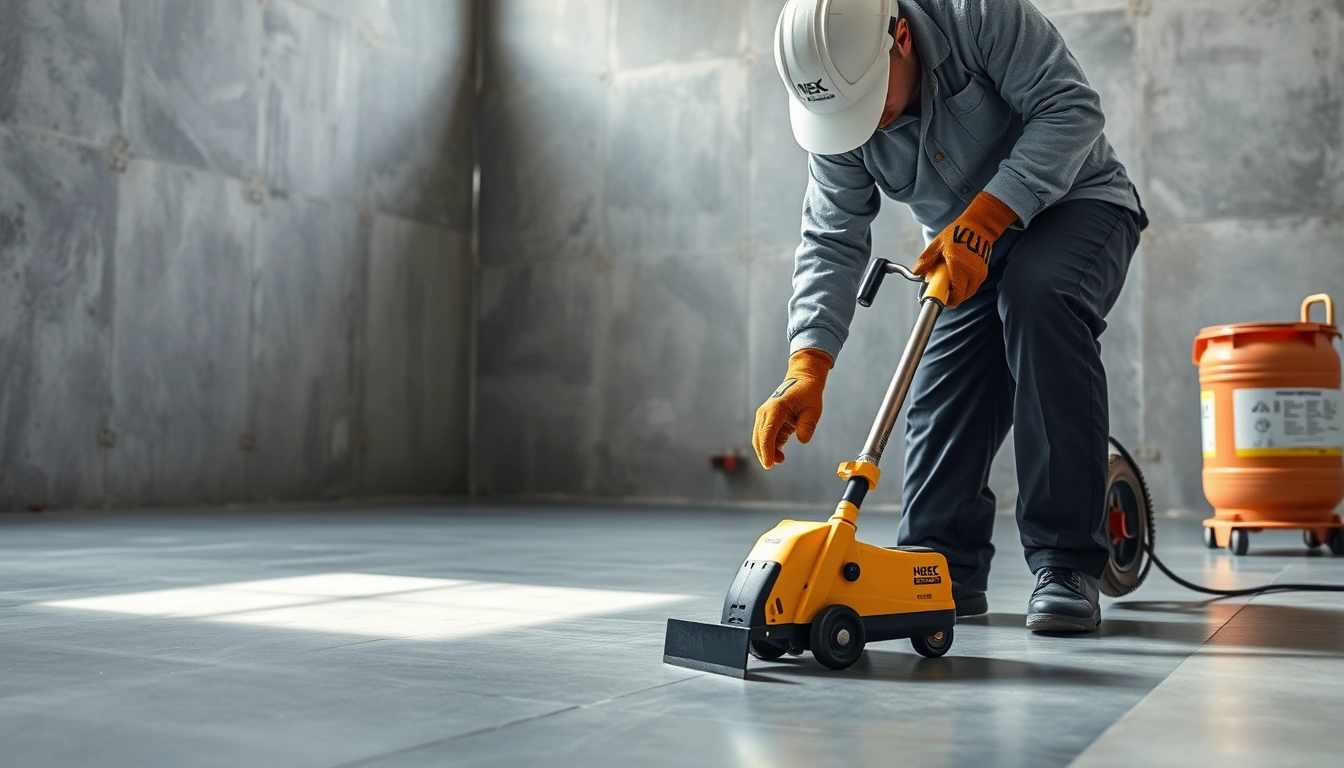
You fix an OSHA trip hazard by identifying the exact condition first. A heaved slab, a settled slab, a structural crack, and a deteriorated control joint all need different repair methods, even though the 1/4-inch threshold is the same.
Before repair starts, mark the area, document the measurement, and barricade the hazard. That shows the condition was identified and managed, which can matter during an inspection.
Step-by-step process for OSHA trip hazard repair
- Measure the vertical displacement. Use a 4-foot straightedge across the elevation change and measure the gap with feeler gauges or a digital caliper. Record the measurement in both millimeters and inches. Anything at or above 1/4 inch (6.4 mm) is a formal trip hazard under OSHA 1910.22.
- Identify the hazard type. Determine whether the issue is a heaved joint, a settled slab, a surface crack with edge spalling, or active movement between crack faces. Each condition follows a different repair path.
- Select the correct repair method. For a heaved control joint under 1/2 inch, diamond grinding can flush the edge. For a settled slab, polyurethane foam injection can raise the panel back to grade. For a structural crack with face displacement, use epoxy crack injection before any grinding.
- Prepare the repair zone. Saw-cut 2 to 3 inches back from the hazard edge if surrounding concrete is spalled or undermined. Remove dust, oils, and loose debris so the repair material can bond properly.
- Execute the repair within the manufacturer’s temperature window. Most industrial epoxy products require substrate temperatures between 40°F and 90°F. For polyurethane foam slab lifts, drill injection ports at 4-foot intervals along the settled panel perimeter and inject in controlled passes.
- Verify elevation after cure. Re-measure with the same 4-foot straightedge. The repaired surface should be within 1/8 inch of the adjacent surface, not just below the 1/4-inch trigger.
- Document and re-inspect at 30 days. A short-interval check confirms the repair is holding and that no new displacement has appeared adjacent to the repair zone.
A facility that can produce dated inspection records, pre-repair measurements, and post-repair verification presents a very different case to an OSHA inspector than one that repairs only when the floor looks unsafe.
What crack width in an industrial slab requires repair?
Crack width determines both urgency and method in industrial floor slab repair. Any crack wider than 1/16 inch in an industrial environment should be sealed, and any crack wider than 1/4 inch requires structural assessment and repair before the area returns to service.
Crack classification follows ACI 224R, the American Concrete Institute reference guide for crack control in concrete. It separates shrinkage cracks, structural cracks, and active cracks, and each one needs a different response.
That distinction matters because a dormant surface crack does not behave like an active structural crack. If the root cause is still moving, the repair will fail sooner.
| Crack width | Classification | Recommended action | Risk if ignored |
|---|---|---|---|
| 1/16 inch or less | Minor shrinkage crack | Monitor and seal if traffic or moisture exposure is expected | Surface wear and moisture intrusion |
| 1/16 inch to 1/4 inch | Repairable crack | Seal promptly with the appropriate material | Expansion, edge spalling, and joint degradation |
| Greater than 1/4 inch | Structural concern | Perform structural assessment and repair before return to service | Load failure, trip hazard, and possible slab replacement |
Visible cracks are common in industrial concrete, which is why size and movement matter more than the fact that a crack exists. The real question is whether the crack is stable, widening, or tied to a deeper slab issue.
That is also why the broader concrete restoration market continues to grow. More facilities are choosing repair and rehabilitation instead of full replacement when the slab is still structurally sound.
Epoxy crack injection vs. polyurethane foam injection: what is the real difference?
Epoxy crack injection and polyurethane foam injection solve different problems. Epoxy restores structural integrity in cracks, while polyurethane foam lifts settled concrete back to grade.
Use epoxy when the slab is cracked but stable enough to bond back together. Use polyurethane foam when the slab has dropped and the issue is settlement, not cracking alone.
Industrial concrete crack repair vs leveling comes down to whether the defect is structural or positional. That distinction is the foundation of the entire repair plan.
When epoxy crack injection is the right choice
Epoxy crack injection works best for structural cracks that need load transfer restored. It bonds the cracked sections together and helps the slab act as one unit again.
This method is strongest when the crack is stable enough for adhesion and when the surrounding concrete can be cleaned properly. It is not the right choice for a slab that continues to move.
When polyurethane foam injection is the right choice
Polyurethane foam injection is the better choice when a slab has settled below grade. The expanding foam fills voids and lifts the concrete with controlled pressure.
It is especially useful for sunken panels near docks, loading areas, and forklift paths. It is also faster than full replacement when the slab remains structurally sound.
Why the wrong method fails
Repair failures often happen when contractors choose by convenience instead of diagnosis. Grinding a settled slab may flatten a spot temporarily, but it does not restore support.
Likewise, foam injection will not solve a structural crack that needs bonding. The repair has to match the defect, or the problem returns.
Control joint repair: the fix most contractors skip
Control joint repair is one of the most overlooked parts of industrial floor slab repair. Many contractors focus on the obvious crack and ignore the joint edge that is actually creating the trip hazard.
When a joint opens, heaves, or spalls, forklifts and pallet jacks hit the damaged edge again and again. That traffic accelerates the failure and spreads the defect into adjacent slab sections.
The right repair depends on the condition. A heaved joint can often be ground flush, while a deteriorated joint may need sealing, patching, or replacement of damaged sections.
Related guidance is available in control joint failure industrial floor repair, which covers why joint damage often starts before the slab crack does.
Floor flatness FF FL tolerances: what your operations actually need
Floor flatness matters because the operation determines the tolerance. A warehouse that runs standard forklifts does not need the same flatness as a very narrow aisle facility with high-reach equipment.
General industrial operations typically require FF 25–35, while very narrow aisle environments require FF 60 or higher under ANSI MH28.3. If the floor falls short, equipment handling becomes less precise and damage risk rises.
That is why industrial floor slab repair should not focus only on cracks and trips. It should also protect the floor geometry that supports daily material handling.
More detail is available in warehouse floor flatness FF FL requirements.
How do I make my plant floor compliant with safety standards?
You make a plant floor compliant by combining measurement, documentation, and repair. The floor must be safe to walk on, safe to drive on, and verified at regular intervals.
That means the program should cover trip hazards, crack width, joint condition, and flatness. If one of those items drifts out of spec, the floor can fail even when the rest looks acceptable.
What a compliant floor program includes
Start with a baseline survey. Mark every crack wider than 1/16 inch, every vertical elevation change approaching 1/4 inch, and every joint with visible damage.
Then set a recurring inspection schedule. A 90-day cycle is common because it creates enough frequency to catch movement before it becomes expensive.
Next, store dated measurements and photos. OSHA enforcement becomes easier to defend when the facility can prove the condition was tracked and repaired with a documented process.
The industrial slab settlement inspection checklist can help structure that program. It keeps the process organized from docks to aisles to production areas.
What industrial floor slab repair costs when you wait too long
Industrial floor slab repair gets more expensive as the defect spreads. A small crack can often be sealed, but a larger settlement problem can force grinding, lifting, patching, or partial replacement.
That cost escalation is why early action matters. A project that starts as a localized repair can turn into a major interruption if traffic continues over an unstable slab.
For many facilities, the real cost is not just materials and labor. It is downtime, rerouting traffic, inspection exposure, and the risk of a citation after a preventable hazard is already documented.
When to level versus replace
Choosing between repair and replacement depends on the slab’s structural condition, not just the visible damage. If the slab is sound and the problem is settlement or joint displacement, leveling often makes more sense.
If the slab has widespread failure, active structural cracking, or repeated movement across multiple sections, replacement may be the better long-term choice. The guide on when to level vs replace industrial concrete slab gives a practical framework for that decision.
The important point is to avoid waiting until the floor is unusable. By then, the repair options are narrower and the costs are higher.
The repair sequence that actually holds — step by step
Industrial floor slab repair lasts longer when the sequence is correct. The best projects follow a repeatable order: inspect, measure, diagnose, repair, verify, and re-inspect.
That sequence reduces guesswork and keeps the repair aligned with the actual defect. It also creates documentation that helps if the floor is reviewed later by an auditor, insurer, or attorney.
Recommended repair sequence
- Inspect the full floor area. Look for cracks, settlement, spalling, joint damage, and flatness issues in traffic paths.
- Measure every suspect area. Use straightedges, gauges, calipers, and photos to record the condition.
- Diagnose the failure type. Decide whether the problem is structural, settlement-related, or surface-level.
- Select the correct repair method. Match the method to the defect before any work begins.
- Prepare the surface. Clean, cut, grind, or drill as needed so the repair material can bond and perform.
- Complete the repair and verify cure. Check the finished area against the original measurement.
- Re-inspect after 30 days. Confirm that the repair remains stable under normal traffic and load.
This sequence is simple, but it prevents most repeat failures. It also turns industrial floor slab repair into a controlled maintenance program instead of a reaction to emergencies.
How do I know if my warehouse floor needs repair now?
Your warehouse floor needs repair now if any vertical change reaches 1/4 inch, if cracks widen beyond 1/16 inch, or if forklift traffic is hitting damaged joints or settled panels. Those are the conditions most likely to create a trip hazard, equipment issue, or citation.
If the damage is spreading, the floor is telling you the underlying cause is still active. In that case, delay makes the final repair more expensive.
Can I keep using a floor with cracks in it?
You can keep using some cracks temporarily, but only when they are stable, measured, and properly managed. A crack that is widening, spalling, or creating a height difference is not a safe candidate for continued use.
When the crack exceeds 1/4 inch or changes in elevation create a hazard, the area should be repaired before the floor returns to normal service.
What is the best industrial floor slab repair method?
The best method depends on the defect. Epoxy crack injection works for structural cracks, polyurethane foam injection works for settled slabs, and grinding or patching works for certain joint-edge hazards.
There is no single best method for every floor. The right repair is the one that matches the condition and restores safe use.
FAQ
What is OSHA’s trip hazard threshold for industrial floors?
OSHA treats a vertical floor elevation change of 1/4 inch (6.4 mm) or more as a trip hazard under OSHA 1910.22.
What crack width needs repair in an industrial slab?
Cracks wider than 1/16 inch should be sealed, and cracks wider than 1/4 inch require structural assessment and repair before the area returns to service.
Should I use epoxy crack injection or polyurethane foam injection?
Use epoxy crack injection for structural cracks that need bonding and load transfer. Use polyurethane foam injection for settled slabs that need lifting back to grade.
What floor flatness do industrial facilities need?
General industrial operations typically require FF 25–35, while very narrow aisle forklift environments require FF 60 or higher under ANSI MH28.3.
How often should industrial floors be inspected?
A 90-day inspection cycle is common because it helps facilities catch movement, settlement, and joint damage before the repair becomes more expensive.
When should a slab be leveled instead of replaced?
Leveling usually makes sense when the slab is still structurally sound and the problem is settlement or joint displacement. Replacement is more appropriate when failure is widespread or repeatedly active.
Key takeaways for industrial floor slab repair
Industrial floor slab repair starts with measurements, not opinions. If a vertical change reaches 1/4 inch, the floor becomes a trip hazard under OSHA 1910.22 and needs attention.
Crack width also matters. Small cracks can often be sealed, but larger or active cracks need structural evaluation before the area returns to service.
Choose the repair method based on the defect. Epoxy, polyurethane foam, grinding, and joint repair all solve different problems, and the wrong choice usually fails early.
Most of all, document the work. Dated inspections, measurements, and follow-up checks are the difference between a managed floor and a liability problem.
See also: industrial concrete leveling
See also: industrial concrete leveling statistics
See also: when to level vs replace industrial concrete slab
Related: warehouse floor flatness FF FL requirements
Related: industrial slab settlement inspection checklist
Related: control joint failure industrial floor repair
See also: industrial concrete leveling
See also: industrial concrete crack repair vs leveling
See also: industrial floor grinding vs leveling for trip haz